The Pico do Arieiro to Pico Ruivo hike is often sold as a straightforward tick on a Madeira itinerary: park high up, follow PR1 across the ridges, arrive at the island's highest summit. In practice, the route asks better questions. Is the full trail open today rather than merely marked on a map? Will the cloud lift, or will it turn a long exposed walk into a cold navigation exercise? And how will you get back to the car if you finish at Achada do Teixeira? Treat those as the main job, and the mountain day becomes far easier to enjoy.
Check the route status before you build the day around it
PR1 has been affected by closures and restricted sections after weather damage and maintenance, so an old blog post or a route recorded in a hiking app is not enough. Look for the current notice from Madeira's official forest or trail-management channels on the evening before, then check again in the morning. A route can be open in a limited form, with a turnaround point or a diversion that changes both the distance and the logic of your transfer.
This matters more here than on a short levada walk. The classic Pico do Arieiro to Pico Ruivo line follows narrow ridges, uses steep staircases and passes through tunnels. If a closure cuts the middle, you cannot quietly improvise a parallel path across the mountains. I would not drive from Funchal at dawn solely because a booking confirmation says “PR1”; the official status and the conditions at the trailhead carry more weight than the label.
Use the weather forecast as a timing tool, not a promise
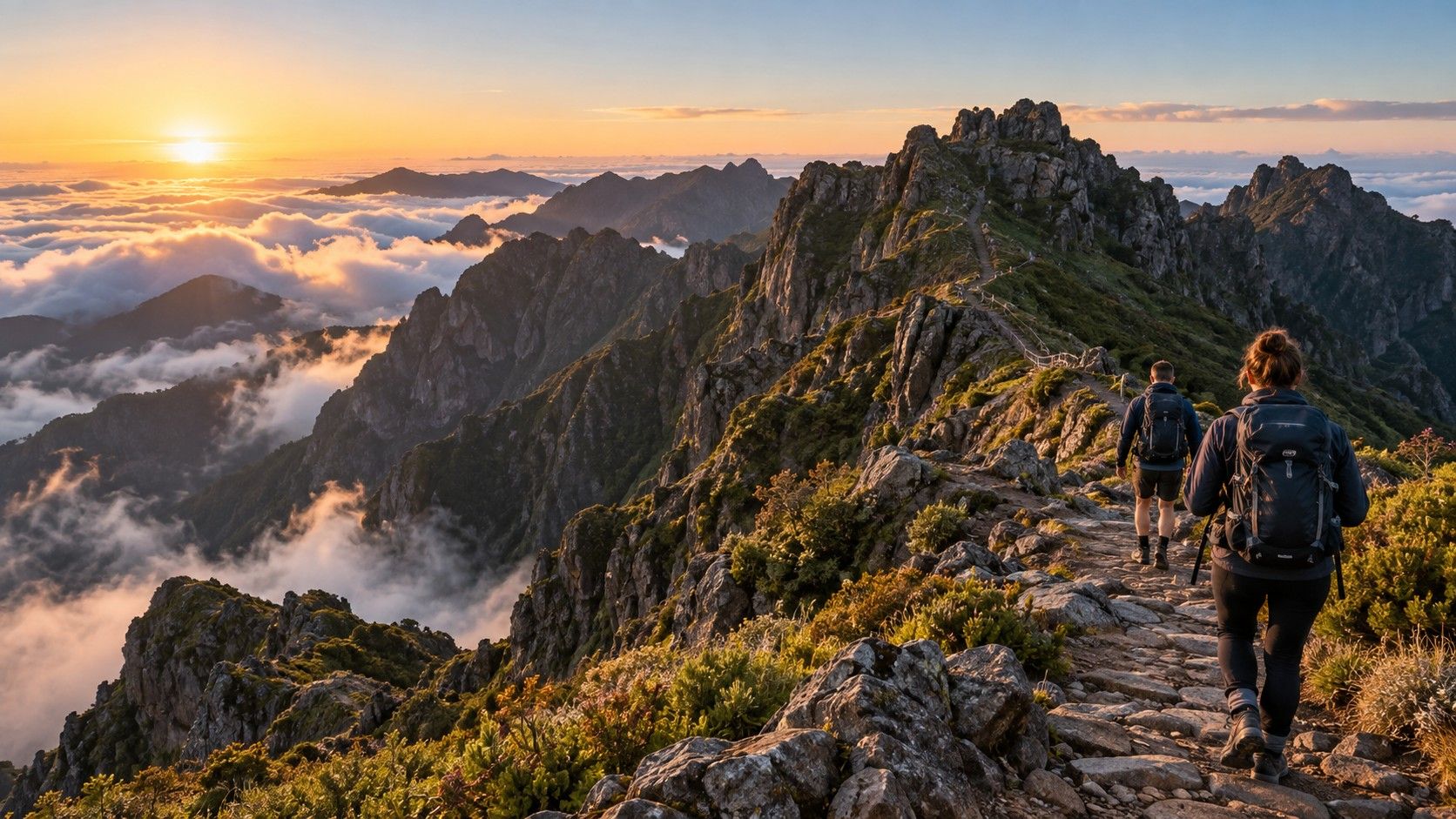
Pico do Arieiro sits above the cloud layer often enough to create the famous sunrise photographs, but “often” is doing a lot of work. Wind, low cloud and fog can arrive quickly on the exposed slopes. Check the mountain forecast rather than the temperature in Funchal, where a calm warm morning says little about conditions near 1,800 metres. Bring a windproof layer even if the coast forecast suggests shorts and a T-shirt.
An early start still has practical value when the sky is not perfect. Parking at Pico do Arieiro gets busier after sunrise, and starting early gives you time to walk at a controlled pace rather than racing a transfer. On a cloudy day, give the view a short window but do not wait indefinitely in the car park hoping for a dramatic reveal. If visibility stays poor, choose the backup while everyone still has energy and daylight. A mountain walk feels much longer when the route is wet, breezy and visually closed in.
| Situation at Pico do Arieiro | Sensible choice | What to check first |
|---|---|---|
| Clear, stable forecast and full PR1 open | Walk one way to Pico Ruivo and descend to Achada do Teixeira | Transfer pickup time and the final descent distance |
| Cloud moving through but trail open | Start only if the group is equipped and comfortable turning back | Wind, visibility and tunnel lighting |
| PR1 partly closed or restricted | Do the permitted viewpoint section, then switch plans | Exact closure point and whether return is required |
| Strong wind, rain or no visibility | Skip the ridge route | Road conditions and a lower-altitude alternative |
Plan the one-way logistics before lacing your boots
The full Pico do Arieiro to Pico Ruivo hike is not naturally a loop. Most independent walkers finish at Achada do Teixeira after visiting the summit, then use a pre-arranged taxi, shuttle or tour transfer to return to Pico do Arieiro or Funchal. That final leg is the detail that catches people out: mobile signal can be patchy, the pickup area is not beside the summit itself, and a casual “we'll call someone later” plan can leave you waiting when the weather has already turned cold.
Book a transfer with a stated pickup point and time, and keep the provider's number saved offline. If you are in a rental car, decide which end receives the car before you start. Two cars solve the problem neatly, although they also require a driver to reposition one. A guided one-way transfer is often worth the small loss of spontaneity for a first visit, especially when the group includes people who do not enjoy negotiating steep mountain roads after several hours on foot.
There is another timing trap. Finishing at Pico Ruivo does not mean you are finished hiking. The descent toward Achada do Teixeira still takes time, particularly on tired knees and damp stone. Build a buffer instead of treating the advertised walking time as a train timetable. Missing a shuttle turns a satisfying route into a very expensive taxi search or a long wait at a high, exposed trailhead.
Distance is the easy number; elevation and stairs decide the day
People sometimes hear that the route is around 10 to 12 kilometres one way, depending on the active alignment and finish, and assume it will behave like a similar distance on level ground. It does not. The PR1 route repeatedly descends and climbs, with steep stepped sections that feel more demanding than the map's clean contour lines suggest. The final approach toward Pico Ruivo asks for effort when legs have already absorbed several hours of uneven terrain.
Fitness helps, but confidence on exposed paths matters too. Some sections have railings; others feel narrow because the drop and wind are close, even where the tread itself is sound. Wear shoes with grip, take water and food, and bring a small torch or headlamp for the tunnels. A phone torch is better than nothing but awkward when one hand wants a railing. If someone in the group is uneasy with heights, it is kinder to find that out at the first viewpoint near Pico do Arieiro than halfway through a committed ridge section.
My rule for this Madeira mountain hike is simple: keep enough reserve to descend safely and make a decision without drama. There is no prize for reaching Pico Ruivo when a person is cramping, shivering or moving so slowly that the transfer becomes doubtful. Turnaround choices are normal mountain choices, not evidence that the day has failed.
Carry the small things that stop a minor problem becoming a long one
The weather can shift by enough to make gloves, a warm layer and a rain shell feel less optional than they did in Funchal. Carry more water than you expect to need, plus something salty or substantial rather than relying on a single sweet snack. There is a mountain hut near Pico Ruivo, but opening arrangements and supplies should never be the only plan for food or shelter. Refill points and services are not scattered along the ridge.
Download an offline map before leaving the hotel and keep the official route information as a screenshot. The marked trail is generally easy to follow when conditions are clear, yet fog changes the character of junctions and staircases. A charged phone, a power bank and a basic first-aid kit are modest additions to a daypack. So is cash: it may help with a small local purchase or an unexpected transport change, but do not depend on finding an ATM near the high trailheads.
Parking deserves a little patience too. At Pico do Arieiro, arriving after the sunrise rush can mean a longer walk from the available space or a more stressful roadside decision. At Achada do Teixeira, do not leave valuables visible if you have staged a car there. These are ordinary travel habits, but mountain-day excitement has a habit of making ordinary habits disappear.
Choose a backup that still fits the weather and your energy
A good backup is not a lesser copy of PR1. If cloud blocks the high ridges, go lower rather than driving between viewpoints in search of a gap. A levada walk at a more sheltered altitude may offer better conditions, although it also needs its own route-status check. Funchal's old town, the botanical gardens, or a slower coastal afternoon can make more sense when the mountain forecast calls for strong wind and rain. Madeira rewards changing the plan earlier than you think you should.
If PR1 is restricted but Pico do Arieiro is accessible, a short walk to the permitted viewpoints can still be worthwhile when visibility is good. Keep the expectation small: you are visiting a high viewpoint, not completing the classic crossing by another name. That distinction prevents a common disappointment, where people walk a short out-and-back section and later discover that the meaningful ridge traverse was never available.
The best version of the Pico do Arieiro to Pico Ruivo hike is therefore a flexible one: current trail information, an early but unhurried start, transport arranged at the far end, and a lower-altitude alternative already chosen. With those pieces in place, you can enjoy the ridges when they are safe and walk away without frustration when Madeira's mountains decide otherwise.